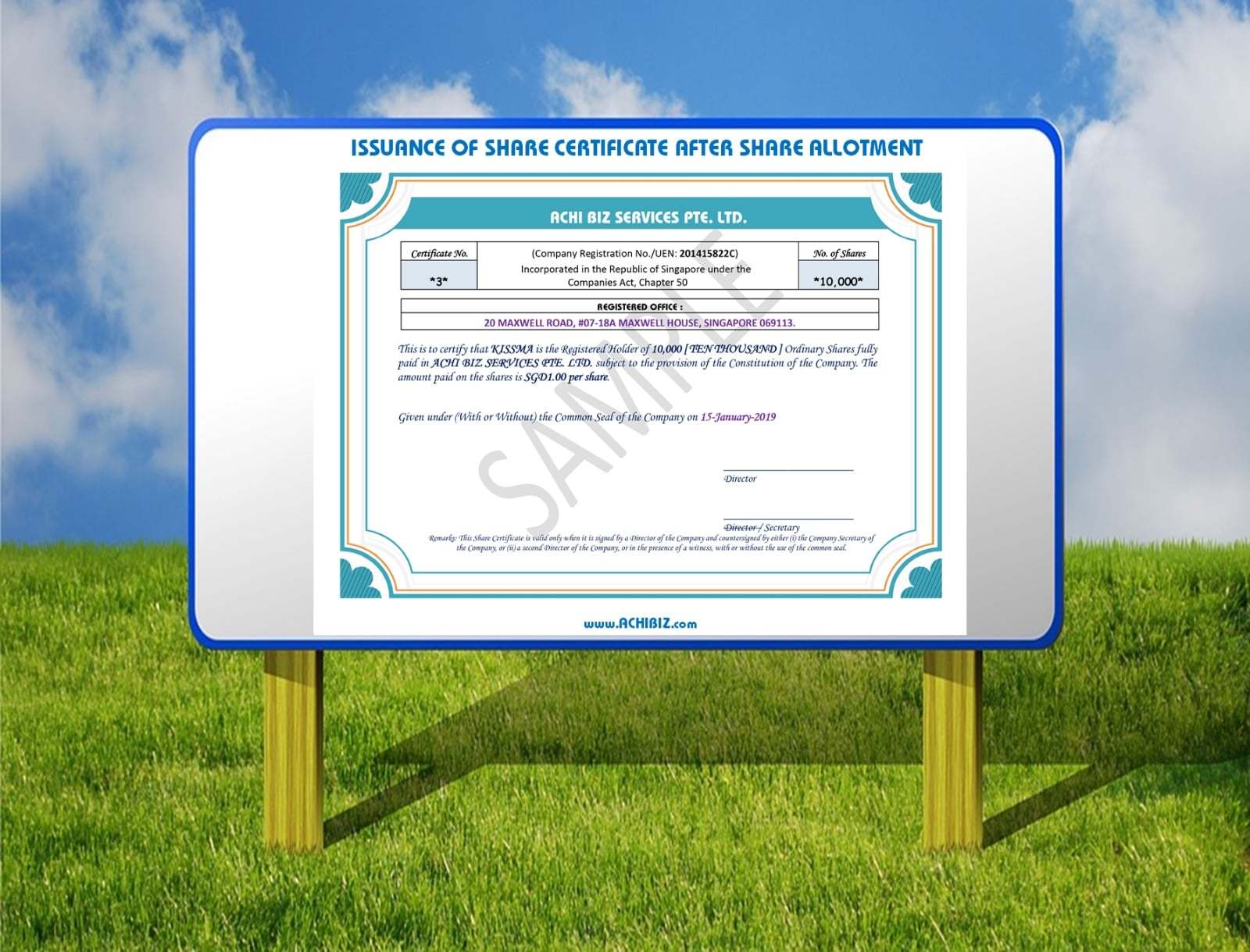
Issuance of New Shares
An issuance of shares is known as an allotment of shares. In an allotment, the subscribers to a company’s constitution agree to take up shares of the company.
The following documents are usually prepared by the company secretary:
- Proposed shareholder’s application to the Company
- A Director’s Resolution in Writing (DRIW) recording the allotment of shares
- A Members’ Resolution in Writing (DRIW) recording the allotment of shares
- Written confirmation of no objection from the existing members
- Authorisation letter to the Company Secretary for lodgement with ACRA
- Lodgment with ACRA for a “Return of Allotment” within 14 days from the effective date
- Preparation of new share certificate(s).
Usually the “Return of Allotment” Form should contain the following information:
- Number of shares in the allotment;
- Amount (if any) paid or deemed to be paid and the amount unpaid on the allotment of each share;
- Where there are different classes of shares, the specific class of shares to which each share in the allotment belongs; and
- Full name, identification, nationality and address of, and number and class of shares held by each of the company’s members; Or
- If the company has more than 50 members, then such particulars of each of the 50 members who hold the most number of shares in the company after the allotment (excluding treasury shares).
- The company is required to have the share certificate ready to be issued to the new shareholders within 60 days after the allotment of shares.
- After the share certificates have been issued to the new shareholders, the company secretary has to update the company’s register of shareholders.
- When the new allotments are made to the Directors then the Director’s shareholding details are also to be updated.
To increase share capital of a newly incorporated private company in Singapore
If your private company in Singapore has been incorporated only with low share capital or even just $1 then you can increase the share capital in just 4 steps:
- (1) Open corporate bank account.
- (2) Inject the desired capital funds into newly opened bank account.
- (3) Prepare documents for increase of share capital.
- (4) File documents for share capital increase / new allotment of shares with authorities.
- Get the updated ACRA business profile with the increased capital.
- Engage a professional Corporate Service Provider (CSP) like ACHI BIZ for seamless capital increase adhere to compliance in Singapore.
Finding of authorized capital versus paid up capital
Authorized capital
The amount of authorized share capital must be listed in the company’s founding documents. Any time the authorized share capital changes, these changes must be documented and made public.
Paid-up Capital
Paid-up capital can be found or calculated in the company’s financial statements. The regulatory authorities require publicly traded companies to disclose all sources of funding to the public
Finding the Paid-up Capital
Paid-up capital (and if any additional paid-up capital) can be found on the company’s statement of financial position (also known as balance sheet) under shareholders’ equity. To calculate paid-up capital, a company must determine the par value of common stock and the number of shares issued to the founding shareholders.
 24/7/365