What is Pongal?
Pongal is a harvest festival celebrated by the Tamil community. It is a celebration to thank the Sun, Mother Nature and the various farm animals that help to contribute to a bountiful harvest. Celebrated over four days, Pongal also marks the beginning of the Tamil month called Thai, which is considered an auspicious month. It usually falls on the 14th or 15th of January each year.
Pongal is also the name of the dish made and eaten during this festival. It is a mixture of sweet boiled rice like rice porridge. It is derived from the Tamil word pongu, which means “to boil over”.
What is Thaipusam?
While it is a thanksgiving festival, its name doesn’t really translate to mean ‘thanksgiving’. Instead, the word ‘Thaipusam’ is a combination of the name of the month, Thai, and the name of a star, Pusam. This festival is celebrated on the full moon day in the Tamil month of ‘Thai’ which coincides with the timing of when the Pusam star is at its highest.
Thaipusam falls around in the last week of every January or first week February based on Hindu calendar. One common misconception is that the festival marks Lord Murugan’s birthday. However, the date actually honours his brave act of vanquishing the demon Soorapadman. The festival also generally lasts for two days, and actually begins on the eve of the day itself. Prior to the festival, worshippers usually spend a month spiritually preparing themselves for the big day, and this includes following a strict month-long vegetarian diet.
What is Chinese New Year or Lunar New Year?
Chinese New Year is also known as the Spring Festival or the Lunar New Year. It’s tied to the Chinese lunar calendar every year, the holiday was traditionally a time to honour household and heavenly deities as well as ancestors. It was also a time to bring family together for feasting.
It is the most important celebration in the Chinese calendar.
In Chinese tradition, each year is named after one of 12 animals, which feature in the Chinese zodiac: Rat, Ox, Tiger, Rabbit, Dragon, Snake, Horse, Goat, Monkey, Rooster, Dog and Pig.
So the animals will have a year dedicated to them once every 12 years, in a cycle.
What is Holi festival?
Holi has been celebrated in the Indian subcontinent for centuries, with poems documenting celebrations dating back to the 4th century CE. It marks the beginning of spring after a long winter, symbolic of the triumph of good over evil. It is celebrated in March, corresponding to the Hindu calendar month of Phalguna.
On the eve of the festival, large pyres are lit in many parts of India to signify the burning of evil spirits. People often throw wood, dried leaves and twigs into bonfires.
On the day of Holi, entire streets and towns turn red, green and yellow as people throw coloured powder into the air and splash them on others. Each colour carries a meaning. Red, for example, symbolizes love and fertility while green stands for new beginnings. People also splash water on each other in celebration. Water guns are used to squirt water, while balloons filled with coloured water are also flung from rooftops. Later in the day, families gather together for festive meals. It is also common to distribute sweets among neighbours and friends.
What is Qing Ming festival?
The Qingming (Pure Brightness) Festival is one of the 24 seasonal division points in China, falling on April 4-6 each year. After the festival, the temperature will rise up and rainfall increases. It is the high time for spring ploughing and sowing. But the Qingming Festival is not only a seasonal point to guide farm work, it is more a festival of commemoration.
The Qingming Festival sees a combination of sadness and happiness.
This is the most important day of sacrifice. Both the Han and minority ethnic groups at this time offer sacrifices to their ancestors and sweep the tombs of the deceased. Also, they will not cook on this day and only cold food is served.
What is Good Friday?
Jesus went through so much for each of us to become heirs of heaven. He became the bridge when there was no bridge. Good Friday is celebrated because deep down, we know the darkness within ourselves. We’re aware of the sins we’ve committed, and we know just how dark our actions and thoughts can be. As we think about the things that have stained our hands, we know deep down, the things we’ve done are worthy of punishment. Especially when we understand God’s holy standards.
Even though the Bible doesn’t tell us to celebrate Good Friday, we observe it and call it Good Friday because it was a good day for humankind! God demonstrated his love for us through the perfect sacrifice of Jesus. “But God demonstrates his own love for us in this: While we were still sinners, Christ died for us.” “For Christ died for sins once for all, the righteous for the unrighteous, to bring you to God. He was put to death in the body but made alive by the Spirit.”
What is Vaisakhi Festival?
Though Vaisakhi is celebrated with vigour in many North Indian states (Punjab, Himachal Pradesh and Uttarakhand), it holds special significance for Punjabis and Sikhs, primarily for four reasons. First, it marks the beginning of their solar year and the harvest of rabi crops. Since Punjab is primarily an agrarian state, this day holds greater importance as farmers thank their gods for good harvest and hope for another good year.
Second, it was on this day in 1699 that Guru Gobind Singh, the 10th Sikh guru, founded the Khalsa Panth and famously evoked nationalism and unity among his people at a meeting in Anandpur Sahib.
What is Ramadan & Hari Raya Puasa?
The Muslim community all over the world celebrate Hari Raya Aidilfitri, or also known as Hari Raya Puasa, to conclude the Ramadan holy month of fasting. Hari Raya Aidilfitri is regarded as a merry celebration as it marks a person’s triumph and success on discipline and self-resistance which symbolizes refinement and rebirth.
It is necessary for Muslims to fast during the month of Ramadan, where they have to maintain their self-resistance in satisfying their basic needs and urges between sunrise till sunset. They abstain from food and drinks, as well as from smoking and sexual relations. It is also important that they keep their minds pure and not harbor any ill thoughts or intentions during this holy month.
What’s the difference between Hari Raya Puasa and Hari Raya Haji?
Puasa vs. Haji: “Hari Raya” directly translates to “Great Day” in English. “Haji” means “pilgrim to Mecca”, while “Puasa” means “fasting”.
Celebration and pilgrimage:
Hari Raya Puasa is celebrated at the end of the Ramadan fasting month to celebrate, well, the end of the fasting month.
Hari Raya Haji is celebrated at the end of the Hajj (pilgrimage) 70 days after the Ramadan – every able-bodied and financially able Muslim is obliged to make the pilgrimage to Mecca in Saudi Arabia at least once in their life.
What is Tamil Puthandu (Tamil New Year)?
Tamil New Year, also known as Puthuvarusham and Puthandu, is the very first day in the Tamil calendar and therefore is celebrated nothing less than a festival. Its date is set according to the Hindu calendar’s solar cycle and every year, it falls in April, mostly on the 14th.
In the Hindu community, the same day is celebrated as the traditional new year and is known by different names in different regions. For example, it is called Vishu in Kerala and Baisakhi in central and northern India.
The Tamil New Year is celebrated with great joy with people greeting one another with Puthaaṇdu vaazhthugal or Iṉiya puthaandu nalvazhthugal which translates to Happy New Year.
The day is mainly celebrated as an excuse to spend quality family time. People clean their house; decorate a tray with flowers, fruits, and other auspicious items. They also visit local temples and light up their family Puja altars. This is also the day to wear new clothes and seek blessings from elders. People also cook a complete vegetarian feast on this day.
What is Vesak Day?
Vesak Day, is an annual religious festival celebrated by the major Buddhist denominations in Singapore. While it is often referred to as “Buddha’s Birthday”, its actual significance is to mark the birth, enlightenment, and passing of Gautama Buddha, and is considered one of the most significant occasions in Buddhism
Vesak Day is usually celebrated on the first full-moon day of the Vaisakha month in the lunar calendar and typically lasts for a full day. This translates to April or May in the Gregorian calendar.
What is Dragon Boat Festival?
The Dragon Boat Festival, or Duanwu Festival, is celebrated every year on the fifth day of the fifth month the Chinese Lunar Calendar. Because of this, the holiday is often called the ‘double fifth’ festival. It is not a public holiday in Singapore but it is nevertheless a widely observed cultural event.
In Singapore, you know you’re in the thick of Dragon Boat Festival when Chinese relatives start preparing rice dumplings. This is also the time when dragon boaters take to our rivers and channels for epic races set to the beat of drums. Dragon Boat Festival will likely be a more muted affair once again this year, but we take the time to look back on its origins and traditions.
What is Hari Raya Haji?
Hari Raya Haji, also known as Aidiladha and alternatively spelt as Eid al-Adha or Eid Adha (Great Day of Sacrifice), is a festival observed by Muslims. It falls on the 10th day of Zulhijjah (the 12th month in the Islamic calendar). Hari Raya Haji is celebrated to mark the end of the haj, the holy pilgrimage to Mecca that all Muslims are encouraged to make at least once in their lifetime. It is one of two major Muslim festivals in Singapore that is celebrated as a public holiday, the other being Hari Raya Puasa.
What is Hungry Ghost Festival (Zhong Yuan Jie)?
Zhong Yuan Jie takes place on the seventh month of the Lunar calendar. It is mostly observed by Chinese Buddhists and Taoists who believe that during this time, colloquially known as “seventh month” (“seventh month” in Chinese), the gates of Hell are opened, releasing spirits who roam the earth.
The period is also commonly referred to as “Hungry Ghost Festival”, with reference to the belief that spirits are hungry because they do not have descendants to make offerings to them. However, it is not just mischievous spirits who roam the earth during the seventh month – it is also believed that dead ancestors may come back to observe the living.
Hence, there are various practices associated with entertaining and appeasing these spirits. For instance, believers will burn joss sticks, paper offerings and make food offerings. There will also be large-scale performances called getai which provide entertainment to both the spirits and the living.
What is the National Day of Singapore?
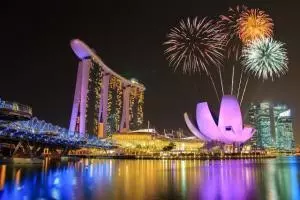
National Day of Singapore is celebrated every year on August 9, in commemoration of Singapore’s independence from Malaysia in 1965. This holiday features a National Day Parade, an address by the Prime Minister of Singapore, and fireworks celebrations.
Audience members sit back to enjoy a stunning spectacle of military parades, multicultural song-and-dance performances and aerial high jinks capped by a breathtaking firework extravaganza set against the stunning cityscape framed by the Marina Waterfront.
While National Day officially falls on the 9th of August, rehearsals for the occasion begin three to four months in advance, with preview shows on the two weekends leading to the celebration.
If you’re in the vicinity on a Saturday, be sure to stick around for the chance to witness the fireworks. While timings tend to vary, you’ll be able to witness this spectacular display from around 8pm.
What is Mid-Autumn Festival?
The Mid-Autumn Festival, or the Mooncake Festival as it is commonly known in Singapore, is celebrated by Chinese communities all around the world. It falls on the 15th day of the eighth month of the Chinese Lunar Calendar, when the moon is believed to be at its fullest. The festival is a time for families to bond together while consuming mooncakes, pomelos, and tea, while children often play with lanterns.
The Mid-Autumn Festival is likely to have origins in ancient worship practices of the moon, and served as a harvest festival to express gratitude to the gods. There are many myths surrounding the origins of the Mid-Autumn Festival, and the most common one is the story of Chang E, the wife of Hou Yi. Several versions of this myth exists, and in a commonly cited version, she drinks the elixir of immortality to save her people from the eternal tyranny of an immortal Hou Yi, who had become an arrogant and domineering ruler. When Chang E drank the elixir, she found herself transported to the heavens. Chang E has been traditionally worshipped by the Chinese community as the Moon Goddess. Other myths associated with the festival include the pounding of medicine by the Jade Rabbit and Wu Gang, the woodcutter.
The festival is also linked to the war between the Han Chinese resistance army and the Yuan Dynasty in the mid-14th century. According to folklore, the rebellion used mooncakes to hide messages that called for an uprising on the night of mid-autumn.
What is Prophet Muhammad’s birthday aka Maulidur Rasul or Mawlid?
This illuminated manuscript contains texts that are recited or sung during the celebrations to commemorate the Prophet Muhammad’s birthday (mawlid). The Prophet’s birthday (12th day of the Islamic month of Rabi’-ul Awwal) is marked in many Muslim communities with religious sermons, and the recitation of stories on the Prophet’s life. The Prophet’s name Muhammad is written in a large bold style in various places, possibly to emphasise that he is the subject of the book.
What is Deepavali?
Deepavali, or Diwali, is a festival that falls between October and November of the Gregorian calendar, and in the Tamil month of Aipasi. Known as the “festival of lights”, the myths and origins of Deepavali differ among North and South Indians but celebrate a common theme of good over evil or light over darkness.
Deepavali is celebrated by Hindus, and also Indians of other religions such as the Sikhs and the Jains. The significance of certain rituals or practices varies amongst the different religious communities.
During Deepavali, the doorways of homes are decorated with diyas (small clay oil lamps) and rangoli (also known as kolam)—intricate patterns made from coloured rice powder or rice grains. Lighted diyas are placed at doorways to draw auspicious energies into the home. The lighting of oil lamps also signifies the triumph of good over evil.
Traditionally, Deepavali is celebrated in many parts of India with prayers, food and the lighting of firecrackers. This is, however, not practised in Singapore, due to safety issues, as well as the need to reduce noise pollution. Instead, kids and adults alike have their fun lighting dozens of sparklers.
What is Christmas (X’Mas)?
Christmas is celebrated on December 25 and is both a sacred religious holiday and a worldwide cultural and commercial phenomenon. For two millennia, people around the world have been observing it with traditions and practices that are both religious and secular in nature. Christians celebrate Christmas Day as the anniversary of the birth of Jesus of Nazareth, a spiritual leader whose teachings form the basis of their religion.
In Singapore, Christmas celebrations are not unique. Christmas in Singapore is like that in any cosmopolitan city – malls are decked with glittery tinsel, twinkling fairy lights, Nativity scenes and other lavish decorations. The trend for buildings and malls dressing up in festive finery started in the early 1980s. The Christmas light-up along Orchard Road has become a tourist attraction.
What is New Year’s Eve?
New Year’s Eve is one of the largest global celebrations because it marks the last day of the year in the Gregorian calendar, December 31, before the New Year. Count down to the New Year no matter where you are in the world.
New Year’s Eve is a day of mixed feelings for many people. On one hand, it is a time to celebrate the end of the year gone by and welcome what is in store in the New Year. On the other hand, some people experience a sense of nostalgia as they reflect on the events that took place in their lives in the past 12 months. Many people start thinking about New Year’s resolutions at this time of the year.
Some people celebrate New Year’s Eve by attending midnight church or temple services, while others gather around in public venues for entertainments such as lighting of firecrackers, etc.
 24/7/365