Achi Biz GuidesComparison of Entities

Comparison Of Business Firms And Entities In Singapore

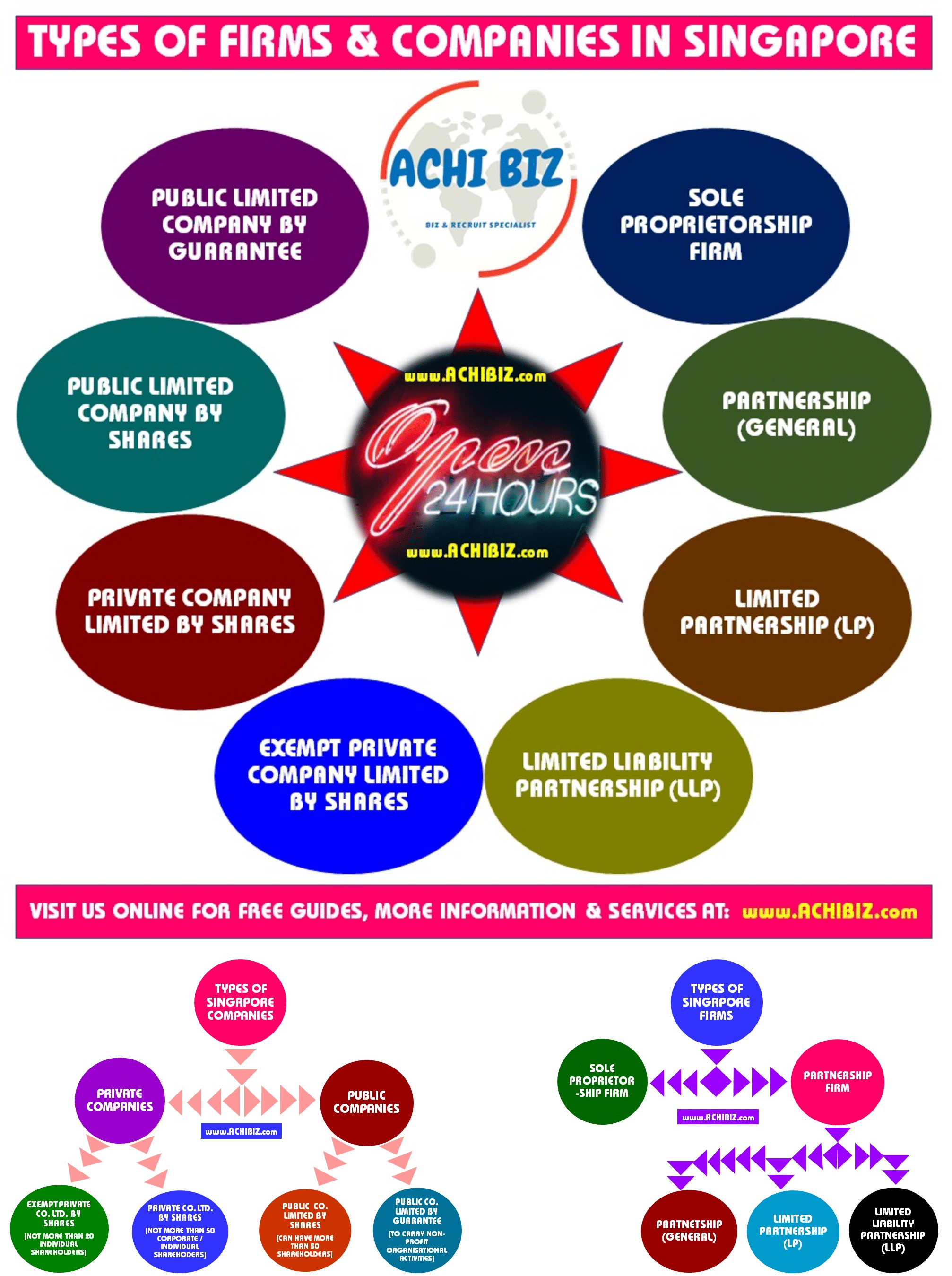
Here we bring you to a comparison together with the chart of pros / advantages or cons / disadvantages of different types of business structures / forms / organisations / firms / entities in Singapore.
Click the below links to view with different comparisons as you need:

COMPARISON OF SINGAPORE BUSINESS ENTITIES (V-201901)
Features
Introduction
One of the most preferred corporate vehicle for wider range of business journey
A basic & simple form of starting the business vehicle
A basic form of business vehicle with two or more co-partners
Often used as investment vehicle for large projects requiring substantial source of cash
Hybrid form of business vehicle consisting both company and typical partnership
Suitability of Business Vehicle
Suitable for carrying all types of business activities including professional services
Suitable for a small scale business with low risks
Suitable for a small to medium size of business journey with co-partners
Flexibility for allowing a diversification of a portfolio
Suitable to carry professional services such as Law Firm, Audit Firm, etc
Defination
A business form which is a legal entity separate and distinct from its shareholders and directors
A business owned by one person
An association of two or more persons carrying on business in common with a view to profit
A partnership consisting of two or more persons, with at least one general partner and one limited partner
A partnership where the individual partner’s own liability is generally limited
Ownership or Owners
  • Exempt Private Company – 20 members or less and no corporation holds beneficial interest in the company’s shares
  • Private Company – 50 members or less
  • Public Company – can have more than 50 members
  • Only one person
  • Between 2 and 20 partners.
  • A partnership of more than 20 partners must incorporate as a company under the Companies Act, Chapter 50 (except for professional partnerships)
  • At least 2 partners; one general partner and one limited partner.
  • No maximum limit.
  • At least 2 partners.
  • No maximum li ::contentReference[oaicite:0]{index=0}
Legal Identity or Status
  • A separate legal entity from its members and directors
  • Members have limited liability
  • Can sue or be sued in company’s name
  • Can own property in company’s name
  • Members not personally liable for debts and losses of company
  • Not a separate legal entity
  • Owner has unlimited liability
  • Can sue or be sued in individual’s own name
  • Can also be sued in business name
  • Can own property in individual’s name
  • Owner personally liable for debts and losses of business
  • Not a separate legal entity
  • Partners have unlimited liability
  • Can sue or be sued in firm’s name
  • Cannot own property in firm’s name
  • Partners personally liable for partnership’s debts and losses incurred by other partners
  • Not a separate legal entity
  • General partner has unlimited liability
  • Limited partner has limited liability
  • Can probably sue or be sued in firm’s name
  • Cannot own property in firm’s name
  • General partner personally liable for debts and losses of the LP
  • Limited partner not personally liable for the debts or obligations of LP beyond amount of his agreed contribution
  • A separate legal entity from its partners
  • Partners have limited liability
  • Can sue or be sued in LLP’s name
  • Can own property in LLP’s name
  • Partners personally liable for debts and losses resulting from their own wrongful actions
  • Partners not personally liable for debts and losses of LLP incurred by other partners
Requirements For Registration or Formation or Incorporation
  • Minimum of one share.
  • Minimum Paid-up capital is S$1 (SGD One Only)
  • At least one shareholder.
  • At least one director ordinarily resident in Singapore, at least 18 years old.
  • If a foreigner wishes to act as a local director of the company, he can apply for an EntrePass from the Ministry of Manpower (MOM).
  • Undischarged bankrupts cannot be a director and cannot manage a company without approval from the Court or the Official Assignee.
  • Age 18 years or above. Singapore citizen / Singapore Permanent Resident / EntrePass holder.
  • If owner not resident in Singapore, he must appoint an authorized representative who is ordinarily resident in Singapore.
  • Self-employed persons must top up their Medisave account with the CPF Board before they register a new business name, become a registrant of an existing business name, or renew their business name registration.
  • Undischarged bankrupts cannot manage the business without approval from the Court or the Official Assignee.
  • Age 18 years or above. Singapore citizen / Singapore Permanent Resident / EntrePass holder.
  • If owner not resident in Singapore, he must appoint an authorized representative who is ordinarily resident in Singapore.
  • Self-employed persons must top up their Medisave account with the CPF Board before they register a new business name, become a registrant of an existing business name, or renew their business name registration.
  • Undischarged bankrupts cannot manage the business without approval from the Court or the Official Assignee.
  • At least one general partner and limited partner. Both can be individuals (at least 18 years old) or body corporate (company or LLP).
  • If all general partners are ordinarily resident outside Singapore, they must appoint a local manager who is ordinarily resident in Singapore.
  • Self-employed persons must top up their Medisave account with the CPF Board before they register as a partner of a new LP, become a registered partner of an existing LP, or renew their LP registration.
  • Undischarged bankrupts cannot manage the business without approval from the Court or the Official Assignee.
  • At least two partners, who can be individuals (at least 18 years old) or body corporate (company or LLP).
  • At least one manager ordinarily resident in Singapore and at least 18 years old.
  • Undischarged bankrupts cannot manage the business without approval from the Court or the Official Assignee.
Easiness of Registration
  • An easy process to be completed within a few hours however subject to referral to different authorities which may delay up to 14 working days
  • An easy process to be completed within a few hours however subject to referral to different authorities which may delay up to 14 working days
  • An easy process to be completed within a few hours however subject to referral to different authorities which may delay up to 14 working days
  • An easy process to be completed within a few hours however subject to referral to different authorities which may delay up to 14 working days
  • An easy process to be completed within a few hours however subject to referral to different authorities which may delay up to 14 working days
Level of Fees for Registration
High when comparing to other form of business vehicles
Low set up costs among all business vehicles
Renewal Costs
Perpetual succession hence renewal is not applicable
Low costs for renewal
Perpetual succession hence renewal is not applicable
Perception of Business by the Public
Regarded more trust worthy and credibility
Regarded least trust worthy and credibility
Regarded moderate trust worthy and credibility
It is common with specific professions hence it is easily and strongly regarded more trust worthy and credibility
Funding Opportunities
  • Avenue for equities from members including venture capital funding.
  • Obtaining financial loans is relatively easier compared to other form of businesses.
  • Obtaining loans from banks is only by mortgaging the personal assets.
  • Capital injection is limited to the new partner.
  • Obtaining loans from banks is only by mortgaging the personal assets of the partners.
  • Obtaining loans from banks is only by mortgaging the personal assets of the partners.
  • Obtaining loans from banks is only by mortgaging the personal assets of the partners.
Yearly Statutory Obligations
  • Must appoint a company secretary within 6 months of incorporation.
  • Must appoint an auditor within 3 months after incorporation, unless the company is exempt from audit requirements.
  • Annual returns must be filed.
  • Statutory requirements for general meetings, directors, company secretary, share allotments must be complied with.
  • Yearly renewals (one year or three years)
  • CPF Medisave Top-Up required for Self-employed Persons before they can renew sole-proprietorship
  • Yearly renewals (one year or three years)
  • CPF Medisave Top-Up required for Self-employed Persons before they can renew partnership
  • Yearly renewals (one year or three years)
  • CPF Medisave Top-Up required before they can renew LP
  • Annual declaration of solvency / insolvency must be lodged by one of the managers stating whether the LLP is able or not able to pay its debts during the normal course of business.
  • No statutory requirement for general meetings, directors, company secretary, share allotments etc.
Taxation
Profits taxed at corporate tax rates
Profits taxed at owner’ personal income tax rates
Profits taxed at partners’ personal income tax rates
Profits taxed at partners’ personal income tax rates (if individual) / corporate tax rate (if corporation)
Profits taxed at partners’ personal income tax rates (if individual)/ corporate tax rate (if corporation)
Taxation Form
ECI & Form C or C-S
Form B
Form P for Partnership & Form B for respective Partners
GST Implication
GST obligation is at entity level based on own turnover
Based on combined turnover of all of your sole proprietorship firms plus income derived from other trades, professional services or vocation
Based on combined turnover of all partnership businesses with the same composition (structure) of partners
Perpetual Existence in Law
  • A company has perpetual succession until wound up or struck off.
  • Existence subject to life of the owner and cessation of the business.
  • Existence subject to partnership agreement
  • Existence subject to partnership agreement
  • If there is no limited partner, the LP registration will be suspended and general partners are deemed registered under the Business Registration Act.
  • Once a new limited partner is appointed, the registration of the LP will be restored to “live” and general partners’ registration under the Business Registration Act ceases.
  • The LLP has perpetual succession until wound up or struck off.
Transfer of Ownership
  • Ownership can be transferred by sale and purchase of shares.
  • When the owner exits the sole proprietorship will cease
  • Owner can be changed to somebody else
  • Partners can be changed.
  • Partners or corporate bodies can be changed
  • Partners can be changed
Closing the Business or Deregistration
  • When the owner exits the sole proprietorship will cease
  • Owner can be changed to somebody else
  • Winding Up – Voluntarily by members or creditors, compulsorily by the High Court.
  • Striking off
  • By Owner – Cessation of business,
  • Registrar can cancel registration if not renewed or where Registrar is satisfied business is defunct
  • By general partner – Cessation of business or dissolution of LP.
  • Registrar can cancel registration if not renewed or where Registrar is satisfied business is defunct
  • Winding Up – Voluntarily by members or creditors, compulsorily by the High Court.
  • Striking off

Please refer to GUIDES for Type of Firms & Entities for more details, information or  CONTACT us if you wish to know about these or many other services.